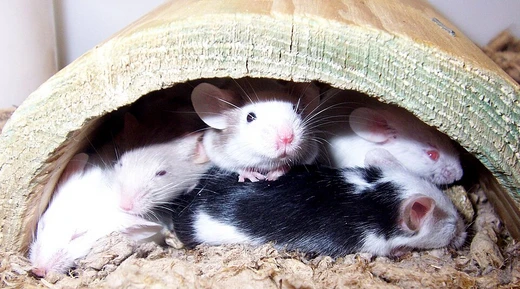
Lagomorpha
Lagomorphs are hare-shaped mammals with four upper incisors.

Lagomorphs are members of the taxonomic order Lagomorpha, comprising two living families: Leporidae (rabbits and hares) and Ochotonidae (pikas). There are 110 recent species, of which 109 are extant, including 42 species of rabbits, 33 species of hares, and 34 species of pikas; one monospecific genus, the Sardinian pika, is recently extinct. Lagomorphs are found on every continent except Antarctica, with introduced populations of European rabbits and European hares in several regions. They are closely related to rodents but are distinguished by having four upper incisors instead of two, and they are almost exclusively herbivores.
- taxonomic_order
- Lagomorpha
- living_families
- Leporidae and Ochotonidae
- extant_species
- 109
- extinct_species
- At least twice as many as currently living (based on fossil record)
- first_described_as_order
- 1912
- key_characteristic
- Four upper incisors; continuously growing teeth; fur-covered paw pads
Lore & Background
The name 'lagomorph' derives from Ancient Greek lagos 'hare' and morphē 'form', meaning 'hare shaped'. It was first used in the 19th century and coined by German naturalist Johann Friedrich von Brandt in 1855, who proposed Lagomorpha as a suborder of rodents. The order was formally described as a distinct order by American palaeontologist James W. Gidley in 1912. Earlier, in 1811, Johann Karl Wilhelm Illiger grouped rabbits, hares, and pikas under the name Duplicidentata, based on their shared four upper incisors.
Reader's Guide
Lagomorphs are significant as a distinct mammalian order closely related to rodents, with which they form the clade Glires. Their evolutionary history is not well understood, but fossil records indicate they were far more diverse in the past, with at least twice as many species as today. The order includes rabbits, hares, and pikas, which occupy a wide range of habitats across all continents except Antarctica. Lagomorphs are characterized by continuously growing incisors and cheek teeth, requiring a high-fiber herbivorous diet to prevent overgrowth. Unlike rodents, they have four upper incisors and lack paw pads, with fur-covered foot soles. Their unique dental and skeletal features, such as a moderately fused postorbital process, distinguish them from other small mammals. The decline of lagomorph lineages in the fossil record highlights ongoing biodiversity loss.
Did You Know?
- Lagomorphs have four upper incisors, while rodents have only two.
- The undersides of lagomorph feet are covered in fur, not paw pads.
- The Sardinian pika is the only recently extinct lagomorph species.
- Lagomorphs were first grouped as Duplicidentata in 1811 before being recognized as a separate order in 1912.
More in Rodents & Small Mammals 1-24
Elsewhere in the Rodents & Small Mammals universe
Spotted an error? Know more?
This is a living reference — every entry is fact-audited, and reader corrections feed straight into our audit queue. Suggest an edit · See this site's audit record