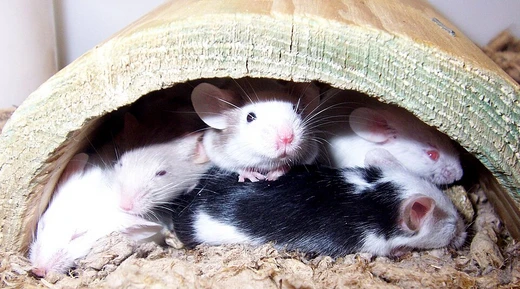
Vole
Small rodents known for rapid reproduction and monogamous behavior.

Voles are small rodents that are relatives of lemmings and hamsters, with a stouter body, a longer hairy tail, a slightly rounder head, smaller eyes and ears, and differently formed molars. They are sometimes known as meadow mice or field mice. Vole species form the subfamily Arvicolinae with lemmings and muskrats, and there are approximately 155 different vole species. Voles are notable for their rapid population growth, their role as prey for many predators, and their use in scientific studies of monogamy, empathy, and genetics.
- classification
- Subfamily Arvicolinae, family Cricetidae, order Rodentia
- size
- 8–23 cm (3–9 in) depending on species
- lifespan
- Most voles do not exceed 16 months in the wild; up to three years in captivity
- gestation
- Three weeks
- litter_size
- Two to nine offspring
- sexual_maturity
- One month
- known_for
- Rapid reproduction, monogamous behavior in some species, vole clock dating method
Lore & Background
Voles are small rodents that grow to 8–23 cm, depending on the species. Most voles do not exceed 16 months in age in the wild, though in captivity they may live as long as three years. The vole mating season spans about half the year, from spring to fall, with litters produced monthly. Each litter is usually made up of two to nine offspring. Gestation lasts for three weeks and the young voles reach sexual maturity in a month. As a result of this biological exponential growth, vole populations can grow very large within a short time; one mating pair can produce 100 offspring every year. Voles thrive on small plants yet, like shrews, they will eat dead animals and, like mice and rats, they can live on almost any nut or fruit. They consume their own body weight in plant material every 24 hours and are known for girdling small trees and ground cover.
Reader's Guide
Voles are significant in ecology as a key prey species for many predators, including martens, owls, hawks, falcons, coyotes, bobcats, foxes, raccoons, squirrels, snakes, weasels, domestic cats, and lynxes. Their bones are often found in owl pellets. In summer 2024, biologists at UC Davis first observed California ground squirrels actively hunting voles. Voles also play beneficial roles by dispersing nutrients throughout upper soil layers. In science, voles are important model organisms: the prairie vole is studied for its monogamous social fidelity, and the woodland vole is also usually monogamous. Research has linked pair-bonding behavior to vasopressin, dopamine, and oxytocin levels. A 2016 study found that voles comfort each other when mistreated, suggesting empathy. Voles have unusual chromosomal traits, including species with 17 to 64 chromosomes, and in one species the Y chromosome has been lost entirely. The vole clock is a method of dating archaeological strata using vole teeth.
Did You Know?
- One mating pair of voles can produce 100 offspring every year.
- As many as 88% of voles die within the first month of life.
- In summer 2024, California ground squirrels were first observed actively hunting voles.
- The prairie vole is a notable animal model for monogamous social fidelity.
More in Rodents & Small Mammals 1-24
Elsewhere in the Rodents & Small Mammals universe
Spotted an error? Know more?
This is a living reference — every entry is fact-audited, and reader corrections feed straight into our audit queue. Suggest an edit · See this site's audit record